
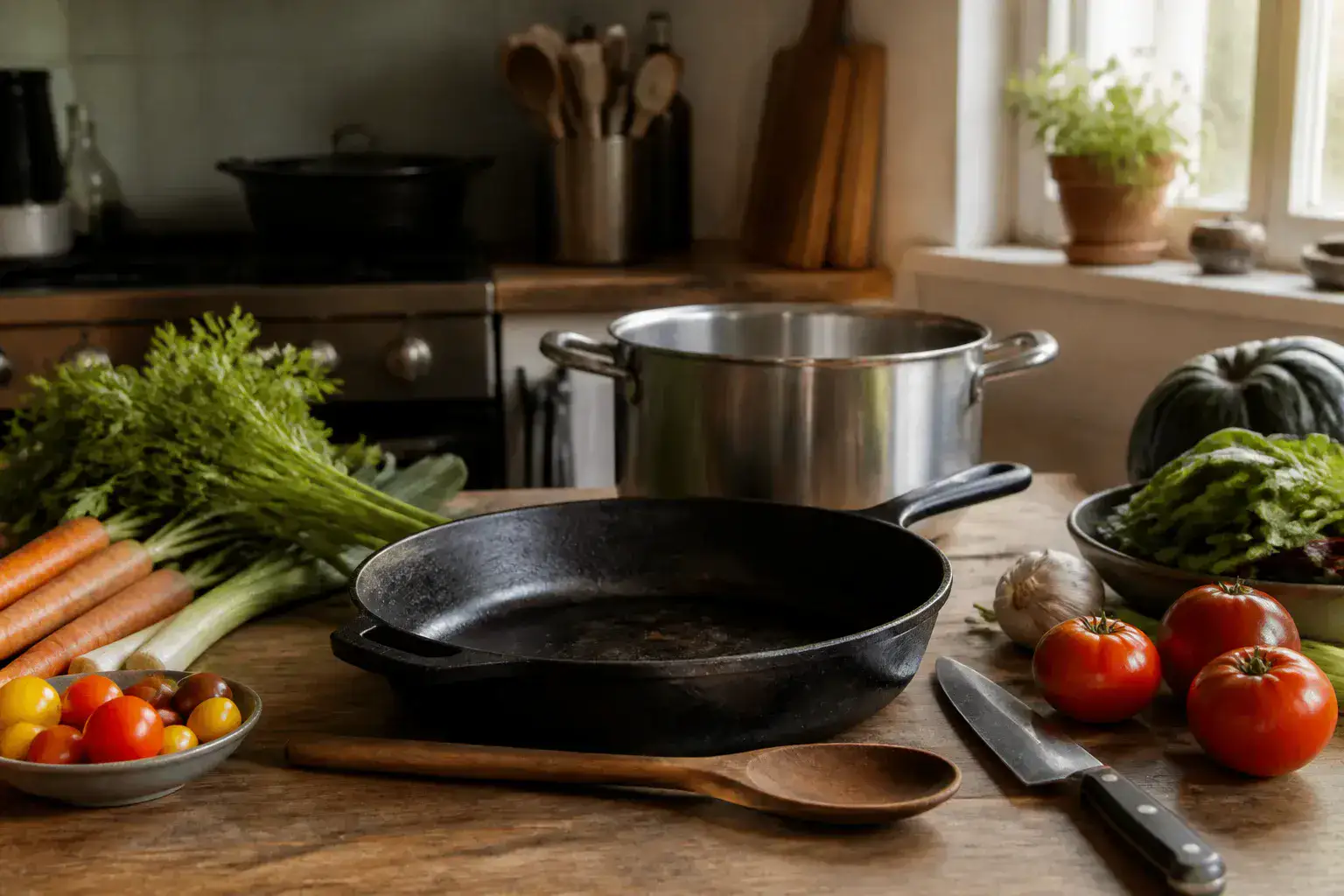
Choose cookware for the food and the care you can realistically give it, not a promise printed on a box.
Start with the meal
A heavy pot that holds a steady simmer is useful for beans and soup. A wide pan makes room for greens and a quick sauté. A sheet pan helps a crowded harvest become dinner. The best first question is what you cook most often, not which material is trending.
Read the manufacturer's care and food-contact instructions for the piece in your kitchen. Avoid making a universal safety claim from a single product description.
Care is part of the tool
Drying, seasoning, replacing damaged parts, and using the right heat all affect how cookware performs. Keep utensils and surfaces clean, and use current food-safety guidance for handling ingredients and leftovers.
A pan that makes a seasonal ingredient easy to cook may do more for a household than a cupboard full of specialized equipment.
Buy less, use more
A small collection can cover most farm-to-table cooking: a pot, a pan, a tray, a knife, and storage containers that match the way you eat. The rest can be added when a real habit asks for it.
That approach also reduces the pressure to treat kitchenware as a wellness product. Food quality starts with good ingredients, safe handling, and a meal you will actually make.
Match material to heat, food, and maintenance
Cookware material is only one part of intended use. The pan's construction, coating, handles, maximum heat, oven compatibility, and care instructions work together. FDA food-contact review considers both the substance and its conditions of use, which is why a blanket verdict about all metal, ceramic, or coated pans is rarely useful.
For a long simmer, choose a stable pot large enough to avoid crowding and boil-over. For a fast sauté, use a pan that responds predictably to heat. For acidic foods, follow the manufacturer's food-contact guidance for that surface. If a vessel is not marked for an appliance or temperature, do not infer compatibility from its appearance.
Weight and grip deserve attention too. Lift the empty pan, imagine it full of soup, and check whether the handle offers control. A technically impressive piece that is painful to move will not become the household workhorse.
Inspect before replacing and before continuing
A maintenance check can be simple: look for a loose handle, unstable base, deep warping, damaged coating, chips, cracks, or residue that ordinary cleaning no longer removes. Compare what you see with the maker's care and replacement instructions. Damage does not have one universal threshold across every material and product.
Use utensils and cleaning aids compatible with the surface. Avoid abrasive or scoring tools where the instructions prohibit them, let thermal shock-prone pieces cool as directed, and keep food-contact surfaces clean and dry between uses. These habits protect performance as well as the surface.
When replacement is justified, buy for the missing task rather than recreating a full set. Record the model and care link while the information is easy to find. The most sustainable pan is not automatically the oldest one; it is a suitable, serviceable tool that can be used safely and often.
A short kitchen inventory prevents duplicate purchases. Note each vessel's size, best task, appliance limits, and care needs. The list makes it easier to recognize a genuine gap, borrow a specialty tool for occasional use, or replace one damaged workhorse with a well-matched piece.