
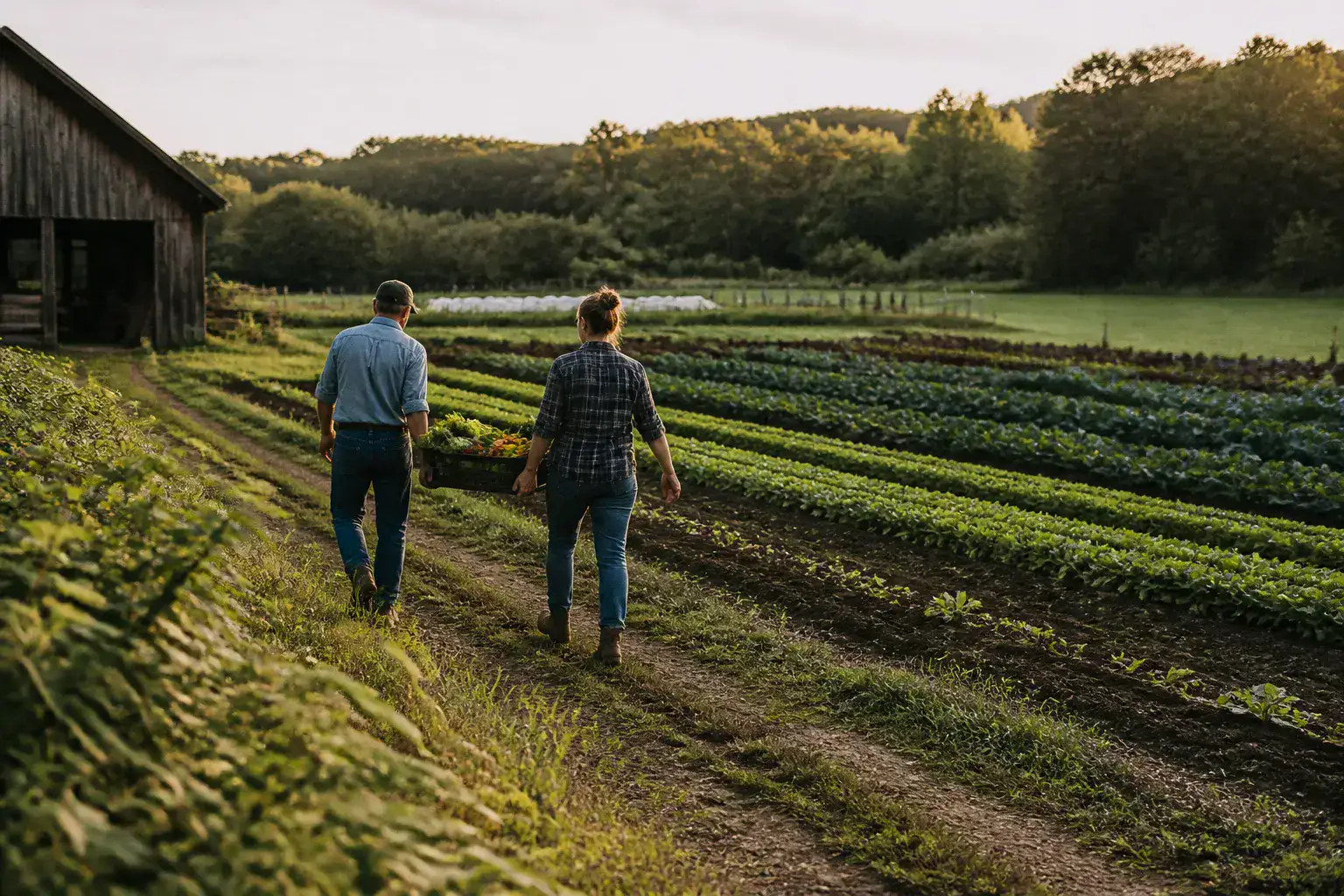
Quality in food is not a single test at the end of a line.
How is food quality built along the chain, from field to product?
Quality in food is not a single test at the end of a line. It is built step by step, from soil preparation and feed choices through milling, mixing, baking or packing, and it depends on someone checking each of those steps. In Italy, that checking is shared between public health authorities and private certification bodies, and the paperwork that matters most for bread and eggs is the one tied to a specific, auditable method rather than to a logo alone.
Quality starts before harvest. A miller who wants consistent flour needs wheat with stable protein content, low moisture and controlled contamination, and those traits are decided in the field by variety choice, sowing date, fertilization and the timing of harvest. The same logic applies to eggs: the hen's feed, the age of the flock, the housing system and the cold chain after laying all leave traces in the yolk color, shell strength and freshness.
At each transfer, from farm to collection point, from collection point to mill or packing station, from there to the bakery or the market stall, a batch is identified and its history recorded. This is what the Italian word filiera, qualità, campo, prodotto describes in practice: a chain of custody where the field, the processing step and the finished product are linked by documents and by physical controls, not only by a label on the shelf.
Two things make that chain hold. The first is traceability: the ability to move backward from a finished loaf or a carton of eggs to the lot of grain or the flock that produced it. The second is consistency: the same method applied on a bad week as on a good one, so that a customer buying the same product in March and in October gets the same result. A chain that only works when conditions are easy is not a quality chain, it is a lucky one.
Who controls food safety in Italy, and at which steps?
Food safety in Italy is not the job of a single body. The Ministry of Health sets the national framework, the Istituto Superiore di Sanità provides scientific advice, and the regional health agencies, the aziende sanitarie locali, carry out inspections at the level of the single business. On the production side, the Carabinieri unit known as NAS, the Nucleo Antisofisticazione e Sanità, runs targeted checks on food businesses, warehouses and markets.
At the European level, the European Food Safety Authority, EFSA, handles risk assessment, while the Directorate-General for Health and Food Safety, DG SANTE, handles policy and audit of national systems. The legal backbone is Regulation (EC) No 178/2002, which sets the general principles of food law and requires traceability at every stage. That regulation is public and can be read in full on the EUR-Lex portal.
The steps where controls concentrate are predictable. On the farm: water, feed, veterinary treatments, hygiene of the laying or milking area. At collection and transport: temperature, timing, condition of the vehicle. At processing: pest control, allergen management, cleaning records, calibration of ovens and pasteurizers. At packaging: labeling accuracy, lot codes, shelf-life validation. At retail: storage temperature, rotation, and the paper trail that lets an inspector reconstruct a batch in minutes rather than days.
For a small farm selling directly, the same obligations apply in reduced form. A producer who sells eggs at a farmers market still needs to register the activity, keep a record of feed and treatments, mark the eggs with the production method and date, and respect cold storage rules. The scale changes, the principle does not.
Which product certifications actually matter for bread and eggs?
For bread and eggs, the certifications that carry real weight are the ones tied to an audited specification, not the ones that only describe a feeling. Four families are worth knowing.
Organic certification. Regulated in the EU by Regulation (EU) 2018/848, it covers the field, the feed and the processing. For eggs, it means the hens are raised under organic feed and outdoor access rules. For bread, it means the grain and the other ingredients meet the same standard. The control body is a private organization authorized by the Ministry of Agriculture, and it inspects the farm and the mill or bakery at least once a year.
Protected designation schemes. DOP, IGP and STG are EU geographical indications. They matter when a bread or a bakery product is tied to a defined area and a defined method, such as a traditional regional loaf. For eggs, geographical indications are rarer, but the same logic applies to products linked to a specific territory.
National quality schemes. Italy's MIPAAF recognizes STG, and also runs the SQNPI, the national integrated production quality system, which focuses on reduced-impact cultivation methods. A loaf made with SQNPI wheat carries a documented field protocol behind it.
Voluntary private standards. BRCGS, IFS and similar schemes are common in the supply chain that sells to supermarkets. They are not law, but a bakery or packing station that holds one has been audited on hygiene, traceability and process control, and that audit is renewed on a fixed cycle.
What does not matter much on its own is a logo with no specification behind it. A label that says "natural" or "genuine" without a published standard, an inspection body and a register of certified operators is a marketing statement, not a certification. The practical test is simple: ask which regulation or which standard the claim refers to, and who verifies it.
What does this mean for a home kitchen or a small farm?
For a home baker or a family buying eggs, the useful habits are the same ones an inspector would use. Read the label for the production method and the date, not only for the brand. Prefer a product whose origin is stated at the level of the region or the mill, because that is a sign the chain is documented. When buying directly from a farm, ask how the feed is chosen and how the eggs are stored after laying; a producer who can answer in specifics is a producer who keeps records.
For a small farm or a market stall, the work is to keep the chain visible. Write down the lot, the date, the supplier and the storage condition, even in a notebook. Keep the cold chain unbroken and the labels accurate. Those two habits cover most of what a routine inspection looks for, and they also make the product easier to sell, because a buyer who can see the method behind the loaf or the egg is a buyer who comes back.
The takeaway
Quality along the chain is a sequence of small, recorded decisions: what is grown or fed, how it is moved, how it is processed, and who checks it. In Italy, that checking is split between public authorities and authorized certification bodies, and the certifications that count for bread and eggs are the ones with a published standard and a real audit behind them. A label is only as good as the method it points to.